
How To Build a Sales Funnel: A Step-by-Step Guide for Business Owners
Most business owners are brilliant at what they do. But when it comes to turning social media followers into paying clients, something breaks down.
The problem is almost always the same: there is no funnel. Without a structured journey from awareness to purchase, you are leaving money on the table every single day.
What Is a Sales Funnel?
A sales funnel is the path a potential customer takes from first discovering your business to making a purchase. It is called a funnel because, at each stage, some people drop off. Your job is to make that journey as smooth and compelling as possible, so more people reach the bottom and convert into clients.
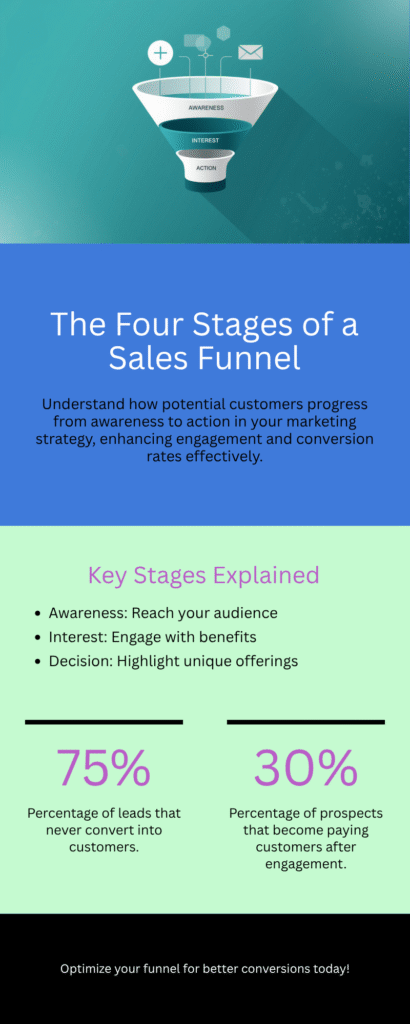
The Four core stages are:
Awareness: the prospect discovers your brand
Interest: they engage with your content or offer
Decision: they consider buying from you
Action: they make a purchase or enquiry
A sales funnel is not a complicated concept. It is simply a mapped-out customer journey, and every business needs one.
Why Most Small Businesses Do Not Have a Working Funnel
The typical small business owner posts on social media, runs occasional ads, and waits for the phone to ring. That is not a funnel. That is hope-based marketing, and it rarely produces consistent results.
Without a funnel, you have no way of capturing leads, nurturing interest, or guiding someone towards a decision. You are essentially broadcasting into a void and hoping the right person sees the right post at exactly the right moment.
Research shows that it takes an average of seven touchpoints before a prospect is ready to buy. Without a funnel, you are relying on chance to deliver all seven. With one, you are engineering them.
Key takeaway: Inconsistent enquiries are usually a funnel problem, not a product or service problem.
How To Build a Sales Funnel: The Five Steps
Step 1: Define Your Target Audience
Before you build anything, you need to know exactly who you are trying to attract. Be specific. A dentist in Manchester targeting nervous private patients needs a completely different funnel to an aesthetics clinic in Marbella targeting cosmetic treatments.
Define your ideal client by: age, location, income bracket, main problem or desire, and where they spend time online.
Step 2: Create an Awareness-Stage Offer (Top of Funnel)
This is typically free content that grabs attention and builds trust. Think blog posts, Instagram reels, short videos, or a downloadable guide. The goal is not to sell. The goal is to demonstrate that you understand the prospect’s problem and can help solve it.
Step 3: Build a Lead Capture Mechanism (Middle of Funnel)
Once someone is interested, you need a way to collect their contact details.
This is usually a lead magnet: a free resource offered in exchange for an email address or WhatsApp opt-in.
Examples include a free audit, a checklist, a mini-guide, or a webinar.
Without this step, you have awareness but no database. You cannot follow up with someone who simply liked a post.
Key takeaway: Your lead magnet is the bridge between social media attention and a real business relationship.
Step 4: Nurture With Value Before You Pitch
Once you have a lead, resist the urge to sell immediately. Send a sequence of emails or messages that educate, reassure, and demonstrate results.
This is where trust is built. By the time you make an offer, the prospect already feels they know you.
A simple three-part nurture sequence might look like this:
Email 1: Deliver the lead magnet and introduce yourself
Email 2: Share a case study or client result
Email 3: Make a soft, time-sensitive offer
Step 5: Convert With a Clear Call to Action
Your conversion point needs to be specific, low-friction, and easy to act on. A booking link, a WhatsApp message, or a free consultation call all work well, depending on your sector.
Vague CTAs like “get in touch” underperform. Specific ones like “book your free 20-minute strategy call this week” convert far better.
Key takeaway: The conversion step fails when the offer is unclear or the next step is too complicated.
A Real-World Example
Consider a cosmetic dentist in Birmingham. They publish a short video on Instagram titled “Five signs your smile is ageing you.”
At the end, they offer a free smile assessment guide in exchange for an email address. Over the next week, they send three helpful emails about cosmetic dentistry, common concerns, and patient results.
On day seven, they invite the prospect to book a complimentary consultation. That is a complete, working funnel, built on organic content and one simple lead magnet.
Key takeaway: You do not need expensive software or a large team. You need a clear offer, a capture mechanism, and a follow-up sequence.
What To Do Next
If you have read this far, you already know more about sales funnels than most of your competitors. The next step is actually building one. That means choosing your audience, creating your top-of-funnel content, and setting up a simple lead capture page.
If that feels overwhelming, that is exactly where Hashtaggz Marketing comes in. We build content-led funnels for businesses in education, healthcare, aesthetics, dentistry, and real estate, across the UK, Costa del Sol, and Dubai.
We create the content, set up the strategy, and make sure the right people find you.
Frequently Asked Questions
What is a sales funnel in simple terms?
A sales funnel is the journey a potential customer takes from first hearing about your business to making a purchase. It maps out each stage, from awareness to action, so you can guide prospects towards buying rather than leaving it to chance.
How long does it take to build a sales funnel?
A basic sales funnel can be built in a week. You need a lead magnet, a landing page, a short email sequence, and a clear call to action. More sophisticated funnels with paid ads and automation take longer, but starting simple is always better than not starting at all.
Do I need a website to have a sales funnel?
Not necessarily. Many businesses run effective funnels using a combination of social media, a simple landing page, and WhatsApp follow-up. A website helps, but it is not a prerequisite for getting started.
How do I get people into the top of my funnel?
Organic content, including social media posts, reels, blogs, and videos, is the most cost-effective way to drive awareness. Paid advertising on Meta or Google can accelerate results, but always ensure you have a lead capture mechanism in place before spending on ads.
What is the most common sales funnel mistake?
Driving traffic to a social media profile or website with no lead capture mechanism. If visitors cannot leave their contact details, you have no way to follow up, and the opportunity is lost.
Can a sales funnel work for a service business?
Absolutely. Service businesses often benefit most from funnels because the buying decision is rarely immediate. A nurture sequence builds the trust required for a prospect to commit to a service, especially at a higher price point.
Ready to Build a Funnel That Actually Works?
Building a sales funnel is not just for tech companies or large brands. It is one of the most powerful things any business owner can do to create consistent, predictable enquiries. If you are ready to stop relying on word of mouth and start building a system that works for you around the clock, let us help.
Want to attract more clients through content that actually converts? Let’s have a quick chat. No pitch, just strategy.
Message us on WhatsApp: https://wa.me/message/ECIMDMVXWHUSN1