
You rank on page one and your enquiries still dropped. That isn’t your SEO failing. It’s the results page changing under you.
When Google shows an AI Overview, the top-ranking page now gets around 58% fewer clicks (Ahrefs, December 2025). And more of your future clients are skipping Google entirely to ask ChatGPT, Perplexity or Claude who to hire.
If your brand isn’t named in those answers, you’re invisible at the exact moment someone is deciding.
Here’s what Generative Engine Optimisation actually is, how it differs from the SEO you already pay for, and what to fix first.
Understanding Generative Engine Optimisation (GEO)
Generative Engine Optimisation (GEO) is the work of making your brand easy for AI answer engines to find, understand, trust and cite. SEO aims for a ranked link. GEO aims for a mention inside the answer itself.
The engines in question are ChatGPT search, Perplexity, Google AI Overviews and AI Mode, Gemini, Claude and Microsoft Copilot.
When someone asks one of them “which British school in Estepona has the best reputation?” or “who’s a good Meta Ads agency in Marbella?”, the AI reads a set of sources, summarises them, and names a handful of businesses. Everyone else doesn’t exist in that conversation.
You’ll also hear the term AEO (Answer Engine Optimisation). For practical purposes, treat GEO and AEO as the same family of work.
One thing to be clear on: GEO doesn’t replace SEO. Most AI answers are built on top of live search results, so a page that can’t be crawled or ranked rarely gets cited. GEO is SEO plus an extra layer focused on clarity, corroboration and citability.
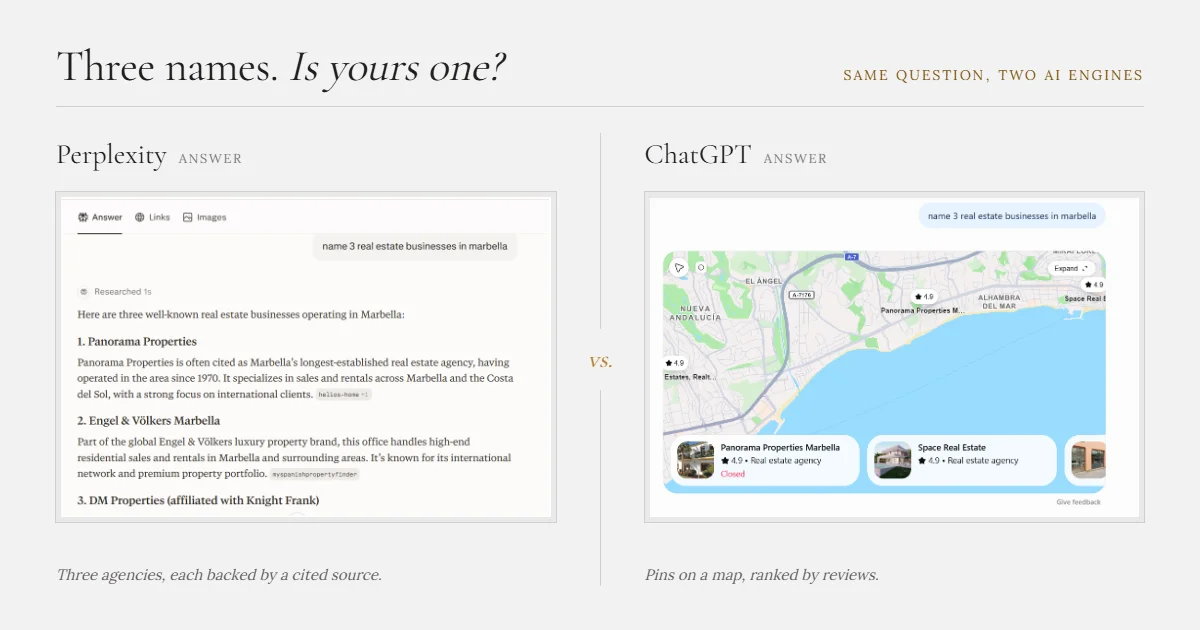
Key takeaway: GEO is about being the business an AI names in its answer, and it sits on top of good SEO rather than replacing it.
Key differences between GEO and traditional SEO
SEO competes for a position in a list of links. GEO competes for inclusion in a single, synthesised answer, where there might only be three or four names.
| Traditional SEO | GEO | |
|---|---|---|
| Goal | Rank a page in search results | Get your brand named or cited in AI answers |
| What you compete for | 10 blue links, plus the map pack | 3 to 5 mentions in one answer |
| Main signals | Relevance, links, technical health, page experience | Clear answers, entity consistency, third-party corroboration, crawlability |
| Where the work happens | Mostly your own website | Your website plus reviews, directories, press, forums and profiles |
| How it’s measured | Rankings, clicks, organic traffic | Mentions, citations, share of AI answers, AI referral traffic |
| Query style | Short keywords (“dentist Marbella”) | Full questions (“English-speaking dentist in Marbella for nervous patients”) |
From keyword density to conversational authority
Let’s be honest: keyword density stopped mattering to Google years ago, so this isn’t a brand-new shift. What AI does is raise the bar.
People ask AI tools full, specific questions. The AI rewards content that answers those questions directly, in plain language, with real detail.
Conversational authority means three things:
- You answer the real questions your clients ask, in the first sentence of the section, not after three paragraphs of warm-up.
- You’re specific. Names, locations, services, prices or price ranges, years in business, results. Vague copy gives an AI nothing to quote.
- Other sources agree with you. Your Google Business Profile, reviews, directory listings, Clutch profile and press mentions tell the same story as your website. AI engines look for corroboration before they recommend anyone.
Key takeaway: SEO rewards the best page. GEO rewards the most clearly and consistently described business across the whole web.
How LLMs index and cite web content in 2026
Large language models don’t index the web themselves. They either answer from what they learned in training, or they run a live search, read a handful of pages, and cite the ones that answer the question best.
There are two routes into an AI answer:
- Training data. What the model absorbed when it was built. It shapes general knowledge about your brand, but it’s a snapshot, it goes stale, and it rarely comes with a link.
- Live retrieval. For anything current, local or commercial, most AI tools now search the web in real time. Google’s AI features draw on Google’s own index. ChatGPT, Perplexity and Claude use their own crawlers alongside search indexes. The AI then picks the sources it trusts most and cites them.
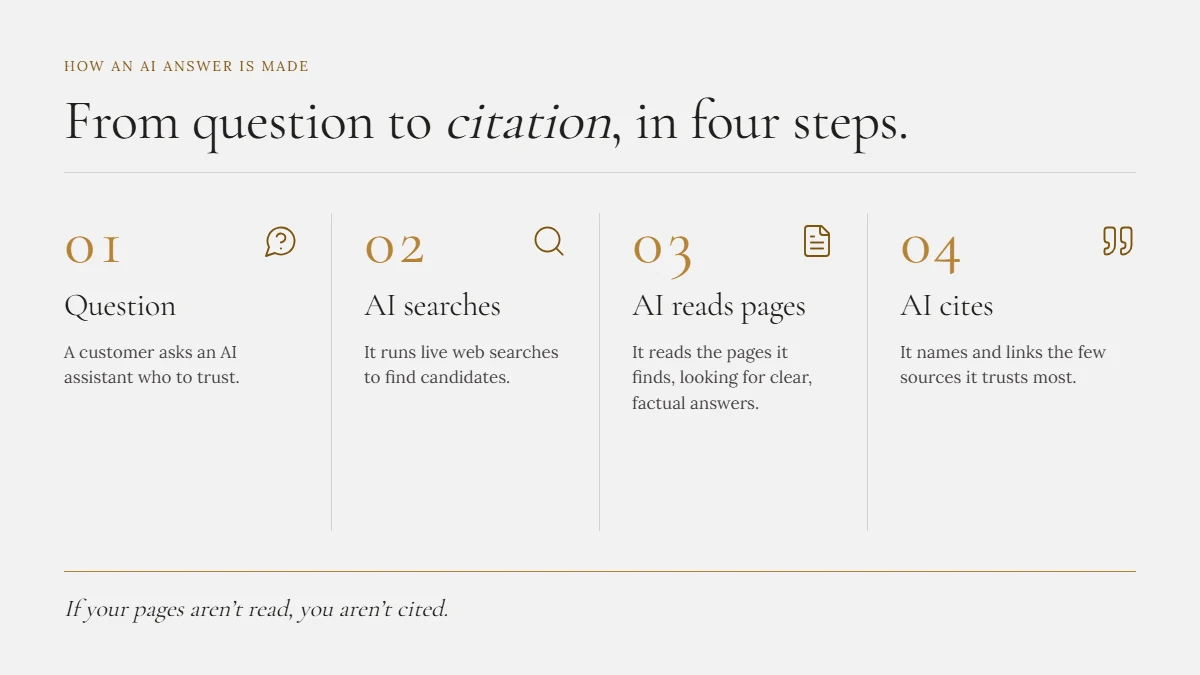
When it chooses what to cite, AI tends to favour pages that:
- Load quickly and show their text without relying on heavy JavaScript
- Answer the question in the opening lines of a section
- Use lists, tables and clear headings that are easy to extract
- Contain specific, checkable facts
- Are backed up by independent sources such as reviews, directories and press
- Are kept up to date
Key takeaway: If an AI can’t retrieve your page, it can’t cite it, no matter how good the content is.
How does structured data help AI systems identify your business?
Structured data (schema markup) labels the key facts on your page in a machine-readable format, so search engines and AI systems can confirm who you are, what you do and where you do it without guessing.
For most service businesses, the essentials are:
- LocalBusiness or Organization schema with your exact name, address, phone, opening hours and service area
- sameAs links pointing to your Google Business Profile, LinkedIn, Clutch, Instagram and other official profiles, so AI can connect them to one entity
- Service schema for each core service
- FAQPage schema on pages with genuine question and answer content
- Person schema for founders and authors, to support expertise signals
A word of honesty: schema isn’t a magic switch. It won’t get you cited on its own.
What it does is remove ambiguity, which matters when an AI is deciding whether “Hashtaggz” on Clutch, on Google Maps and on your website is the same business. It also has to match what’s visible on the page, or it’s worthless.
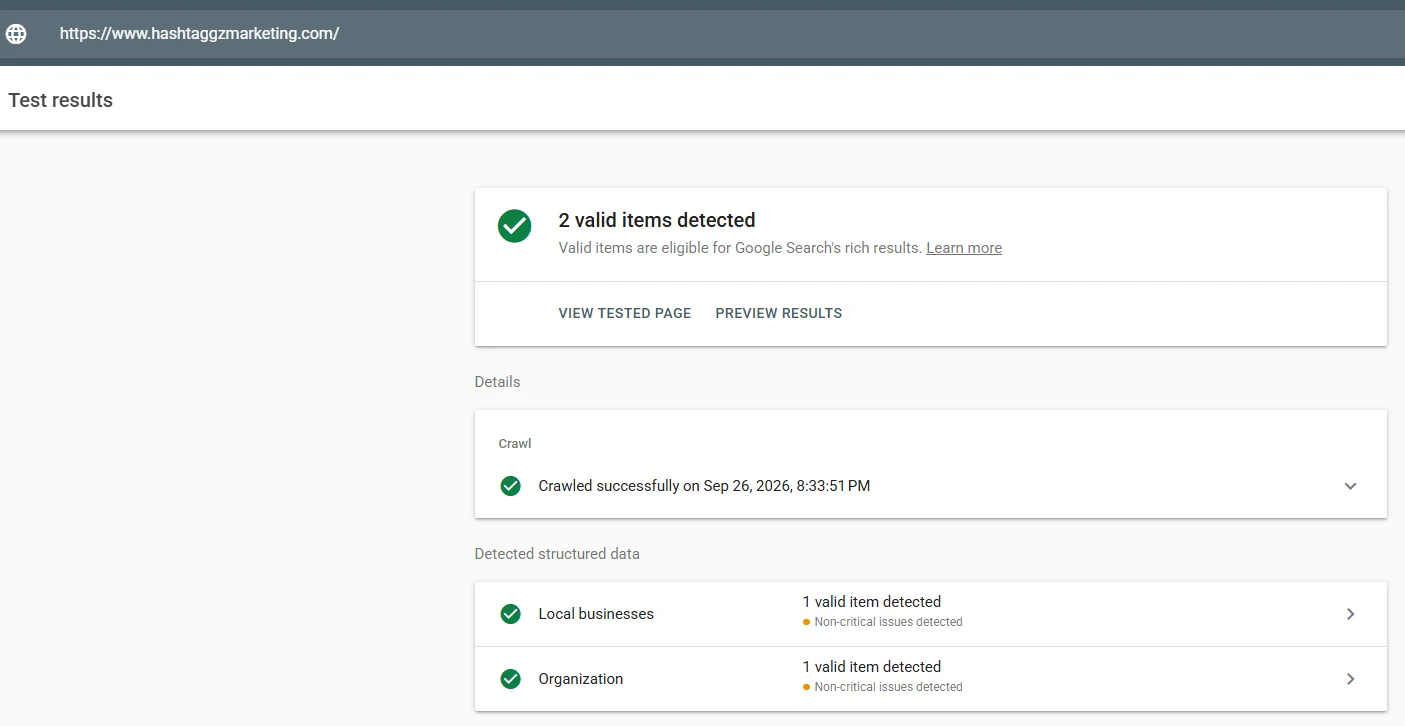
Key takeaway: Structured data makes your business unmistakable to machines, which is the foundation every other GEO effort builds on.
Do llms.txt and open crawler access actually matter?
Crawler access matters a lot. llms.txt matters a little. Fix your robots.txt and firewall settings first.
Open crawler access
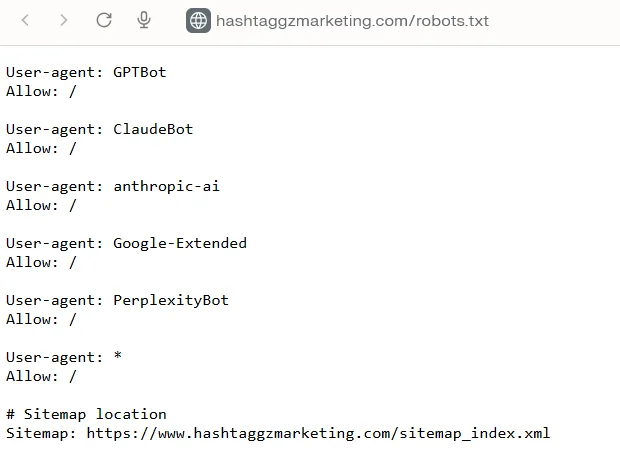
AI companies use named bots to read the web, including GPTBot, OAI-SearchBot and ChatGPT-User (OpenAI), ClaudeBot and Claude-SearchBot (Anthropic), and PerplexityBot.
Some collect training data. Others fetch pages live to answer a question. If your robots.txt, your hosting firewall or a security plugin blocks them, you’ve taken yourself out of the running before the AI has read a word.
Three checks to do today:
- Read your robots.txt (yourdomain.com/robots.txt) and make sure the search and retrieval bots aren’t disallowed. You can choose to block training bots if you prefer, but don’t block the ones that fetch pages for live answers.
- Check your CDN and security settings. Cloudflare and some WordPress security plugins block “AI bots” with one toggle. This is one of the most common silent reasons a business never gets cited.
- Know what Google-Extended does. It controls whether Google can use your content to train Gemini. It doesn’t remove you from AI Overviews, which use the normal Googlebot crawl.
llms.txt
llms.txt is a plain markdown file at the root of your site that lists your most important pages for AI tools to read. It’s cheap and quick to add, and some AI agents and developer tools use it.
But it isn’t a ranking lever. Google’s May 2026 guidance says it isn’t needed for AI Overviews or AI Mode, and a 300,000-domain study by SE Ranking found no measurable link between having one and getting cited.
Add one because it takes 20 minutes and may matter more as AI agents grow. Don’t let anyone sell it to you as the secret to AI visibility.
Key takeaway: An open door beats a signpost. Make sure AI crawlers can get in before worrying about llms.txt.
What is the difference between GEO and traditional SEO for marketing agencies?
For agencies, SEO was mostly an on-site and backlink job, measured in rankings and traffic. GEO widens the job to a client’s entire footprint across the web, and it’s measured in mentions, citations and share of AI answers.
In practice, a GEO-capable agency should be doing things a traditional SEO retainer usually doesn’t:
- Prompt testing. Running the real questions your clients ask through ChatGPT, Perplexity, Gemini and Google AI Mode, and recording who gets named.
- Entity clean-up. Making your name, address, services and positioning consistent across your site, Google Business Profile, directories and profiles.
- Reputation and review work. Reviews and third-party mentions feed AI answers directly.
- Question-led content. Pages and FAQs written around full, conversational questions.
- Technical access. Robots.txt, firewall rules, rendering and schema.
- AI visibility reporting. Tracking mentions and citations over time, not just rankings.
An example from the Costa del Sol
Here’s an illustrative example. A private dental clinic in Marbella ranks second on Google for “dentist Marbella”. Ask ChatGPT for “an English-speaking dentist in Marbella who’s good with nervous patients” and it names three competitors instead.
Why? Those competitors say “English-speaking” and describe their sedation options clearly on their service pages. Their Google reviews mention both. And they’re listed in expat directories.
The fix isn’t more keywords. It’s a page that answers that exact question, FAQ schema, a review request that prompts patients to mention what mattered to them, and consistent directory listings.

If you’re choosing an agency, ask one question: can you show me which AI answers we appear in today? If they can’t, they’re selling SEO with a new label. (We’ve written more on how to choose the best SEO agency in Marbella.)
Key takeaway: SEO agencies optimise a website. GEO agencies optimise how the whole web describes your business.
What to do next
Start by finding out where you stand. Open ChatGPT and Perplexity and ask five questions a real client would ask before hiring someone like you. Note who gets named, and whether it’s you.
If you’d rather have that done properly, run our free AI Visibility Check. It shows whether AI engines can find and cite your business, and what’s stopping them.
When you’re ready to fix it, our AEO and GEO services cover the full job, from crawler access and schema through to content and reputation.
And if you want the bigger picture on how we work, read how an AI-first marketing agency generates more qualified leads.
Frequently asked questions about GEO vs SEO
How does Generative Engine Optimisation differ from traditional SEO?
Traditional SEO aims to rank your web pages in a list of search results. Generative Engine Optimisation aims to get your brand named and cited inside AI-generated answers from tools like ChatGPT, Perplexity and Google AI Overviews. GEO builds on SEO but adds entity consistency, third-party corroboration, question-led content and making sure AI crawlers can access your site.
What is the difference between GEO and traditional SEO for marketing agencies?
SEO agencies mainly optimise a client’s website and backlinks, and report on rankings and traffic. GEO agencies also manage how the wider web describes the client, including reviews, directories, profiles and press, and they report on AI mentions and citations. A GEO-capable agency should be able to show which AI answers a client appears in today.
Does GEO replace SEO?
No. Most AI answers are built on live search results, so pages that can’t be crawled or ranked rarely get cited. GEO is best treated as an extra layer on top of solid SEO, focused on clarity, consistency and citability rather than rankings alone.
Do I need an llms.txt file to appear in AI search?
No. Google says llms.txt isn’t needed for its AI features, and large studies have found no measurable link between having one and being cited. It’s quick to add and some AI agents use it, so it’s worth doing, but open crawler access and clear content matter far more for GEO.
How do I know if ChatGPT recommends my business?
Ask it the questions your clients would ask, such as “best [service] in [town]”, and note which businesses it names. Repeat in Perplexity and Google AI Mode, since results differ between tools. For a structured view, a free AI Visibility Check tests your brand across AI engines and flags what’s stopping you being cited.
Does ChatGPT recommend your business?
Your clients are already asking AI who to hire. The question is whether your name comes up. At Hashtaggz Marketing, we build GEO into how we run SEO for clinics, schools and property businesses across Marbella, the UK and beyond, so you’re visible in Google and in the answers people actually read.
Let’s have a quick chat. No pitch, just strategy.
Sources: Ahrefs, Seer Interactive, OpenAI crawler documentation, llmstxt.org, Schema.org.